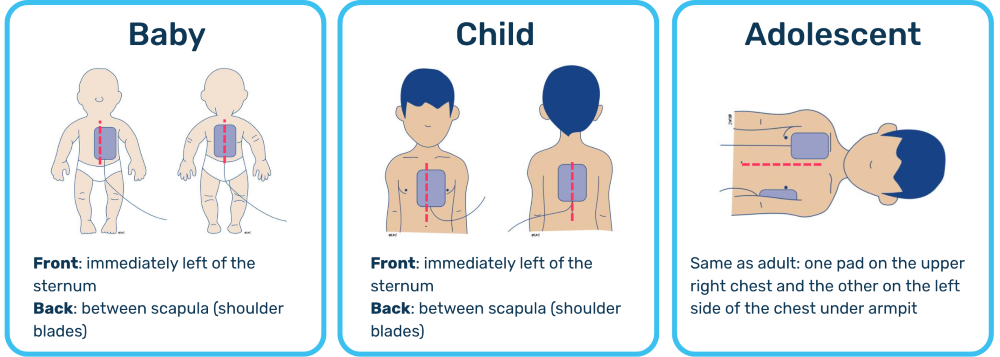
-
- Paediatric pads – suitable for children under 8 years old or weighing less than 25 kg, or
- A paediatric mode or setting – which automatically reduces the energy of the shock.
(30364) *CPR – Using a Defibrillator 2026 to replace (28144) PFA

A defibrillator or AED (automated external defibrillator) is a device that gives a high-energy electric shock to the heart.
We use it if someone is in cardiac arrest (when their heart stops pumping blood around their body effectively).
In simple terms, the purpose of the electric shock is to reset the heart rhythms so that blood can be pumped around the body again.
Fortunately, cardiac arrest in children and infants is rare. When it does happen, their hearts are unlikely to be in a shockable rhythm—the kind of abnormal heart rhythm that an electric shock can correct. Because of this, an AED will often analyse and advise no shock.
Even so, it is essential to apply an AED promptly and follow its instructions, while providing early and effective CPR, to maximise their chance of survival.
All AEDs are designed for adults, but they can also be used safely on children.
Depending on the model, the AED may have: