
Do not waste time getting someone onto the floor from a bed to start CPR. If giving CPR on a bed, increase the compression depth to compensate for the soft mattress.
(29956) **CPR – Cardio Pulmonary Resuscitation 2026 to replace (7718)
What is CPR?

CPR stands for Cardio (heart) Pulmonary (lungs) Resuscitation.
It is a lifesaving first aid technique used when we suspect someone is in cardiac arrest and their heart is no longer pumping blood effectively around the body.
By pressing hard and fast on the chest and giving rescue breaths, you help keep oxygen-rich blood flowing to the brain and other vital organs. This can keep a person alive until emergency professionals take over.
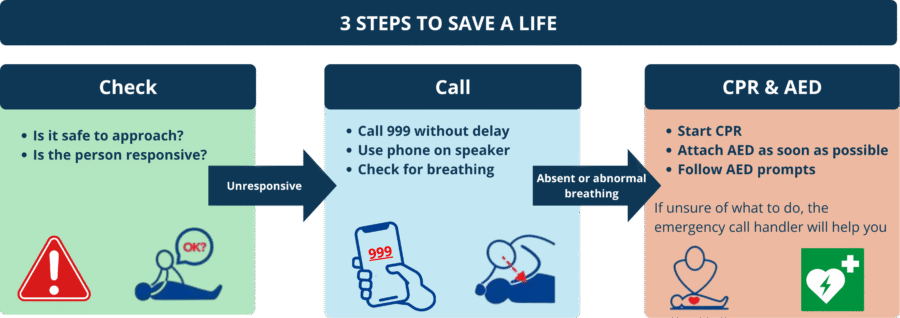
If someone is unresponsive, suspect cardiac arrest and follow the 3 simple steps to save a life
How does an AED work?

An AED (Automated External Defibrillator) is a device that delivers a safe electric shock to the heart when someone is in cardiac arrest. The AED checks the person’s heart rhythm and, if needed, delivers a shock. This shock can help restart the heart or get it back into a normal rhythm.
Research shows that early defibrillation within 3–5 minutes of collapse can increase survival rates to 50-70%.
Watch this video to see how to do CPR and use an AED on an adult:
[ld_video]
You need to watch the video all the way through before you can complete the quiz
FAQ's
Abnormal breathing is any breathing that does not look or sound normal. In cardiac arrest this often appears as slow, laboured and irregular. It may look like the casualty is panting or snorting or they may be taking gasping breaths (called agonal breaths). These breaths may be noisy, shallow, or spaced far apart, and they do not count as normal breathing. You may also notice brief seizure-like movements when someone collapses from cardiac arrest.
If in doubt, start CPR
No — you don’t have to give breaths to perform lifesaving CPR. The 2025 Resuscitation Council UK guidelines say that if you are untrained, unsure, or unwilling to give rescue breaths, you should give chest-compression-only CPR, and this is still highly effective.
However, if you are trained and confident, the guidelines say it is reasonable and beneficial to give both chest compressions and rescue breaths. Adding breaths provides extra oxygen, which becomes more important the longer the resuscitation continues.
In short:
-
- Any CPR is better than no CPR
- Compression-only CPR is absolutely acceptable
- If you are trained and willing, giving breaths is even better
Only leave a casualty to fetch an AED if you can get it and apply it within one minute. If this is not possible, start CPR immediately.
Lesson Content